


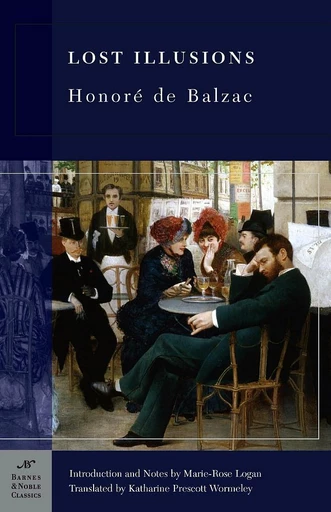
Lost Illusions (Barnes & Noble Classics Series)
Résumé
Lost Illusions, by Honore de Balzac, is part of the Barnes & Noble Classics series, which offers quality editions at affordable prices to the student and the general reader, including new scholarship, thoughtful design, and pages of carefully crafted extras. Here are some of the remarkable features of Barnes & Noble Classics:
- New introductions commissioned from todays top writers and scholars
- Biographies of the authors
- Chronologies of contemporary historical, biographical, and cultural events
- Footnotes and endnotes
- Selective discussions of imitations, parodies, poems, books, plays, paintings, operas, statuary, and films inspired by the work
- Comments by other famous authors
- Study questions to challenge the readers viewpoints and expectations
- Bibliographies for further reading
- Indices & Glossaries, when appropriate
Among the best known of Balzac’s novels, Lost Illusions chronicles the rise and fall of Lucien Chardon, a vain but naive young poet who leaves his provincial home to seek success and fortune in Parisian society. Paralleling Lucien’s disastrously ambitious journey is the story of his friend and brother-in-law, hard-working inventor David Séchard, who is beset by unscrupulous competitors and cheated in his printing business by his own father.
Considered the founder of French realism, Balzac painted equally faithful pictures of the glittering but superficial world of society and the lonely struggle of impoverished men of genius. The city has a corrosive effect on Lucien’s artistic talent and moral strength, while David takes a brave stand against the constraints of provincial small-mindedness. Balzac plays out their contrasting but intertwined stories against the enduring themes of love, ambition, greed, loyalty, vanity, and betrayal. Will Lucien’s debts be the ruin of both?
Published between 1837 and 1843, Lost Illusions is part of La Comédie Humaine, into which Balzac grouped more than ninety interlocking novels. In Lost Illusions, scores of minor characters from these other works help bring early-nineteenth-century France to brilliant life.
Considered the founder of French realism, Balzac painted equally faithful pictures of the glittering but superficial world of society and the lonely struggle of impoverished men of genius. The city has a corrosive effect on Lucien’s artistic talent and moral strength, while David takes a brave stand against the constraints of provincial small-mindedness. Balzac plays out their contrasting but intertwined stories against the enduring themes of love, ambition, greed, loyalty, vanity, and betrayal. Will Lucien’s debts be the ruin of both?
Published between 1837 and 1843, Lost Illusions is part of La Comédie Humaine, into which Balzac grouped more than ninety interlocking novels. In Lost Illusions, scores of minor characters from these other works help bring early-nineteenth-century France to brilliant life.
Marie-Rose Logan received her Ph.D. from Yale and has held teaching appointments at Yale, Rice, Temple, and Columbia. Professor Logan is a recipient of the French government’s Palmes Académiques and of awards from several foundations, including the National Endowment for the Humanities.
Auteur
Caractéristiques
Éditeur : Barnes & Noble Classics
Publication : 1 juin 2009
Intérieur : Noir & blanc
Support(s) : Livre numérique eBook [ePub]
Contenu(s) : ePub
Protection(s) : Marquage social (ePub)
Taille(s) : 1,69 Mo (ePub)
Langue(s) : Anglais
EAN13 Livre numérique eBook [ePub] : 9781411433649
EAN13 (papier) : 9781593083151
Les promos du moment

The milky way
une romance universitaire best friends to lovers

5,99 € 1,99 €

Les oubliés de la Saint-Valentin
Des vies à l'ombre du mariage (États-Unis, XXe siècle)
16,99 € 8,49 €