


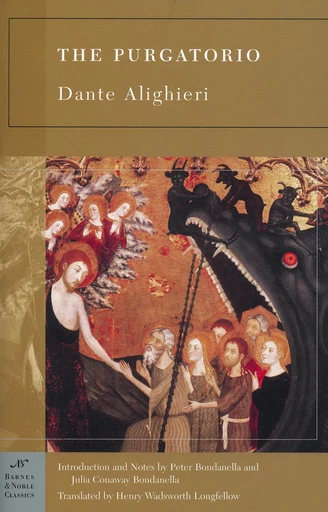
The Purgatorio (Barnes & Noble Classics Series)
Résumé
- New introductions commissioned from todays top writers and scholars
- Biographies of the authors
- Chronologies of contemporary historical, biographical, and cultural events
- Footnotes and endnotes
- Selective discussions of imitations, parodies, poems, books, plays, paintings, operas, statuary, and films inspired by the work
- Comments by other famous authors
- Study questions to challenge the readers viewpoints and expectations
- Bibliographies for further reading
- Indices & Glossaries, when appropriate
Perhaps the greatest single poem ever written, The Divine Comedy presents Dante Alighieri’s all-encompassing vision of the three realms of Christian afterlife. Joyfully anticipating heaven, Purgatorio continues the poet’s journey from the darkness of Hell to the divine light of Paradise.
Beginning with Dante’s liberation from the Inferno, part two of The Divine Comedy follows the poet as he and the Roman poet Virgil struggle up the steep terraces of the earthly island-mountain called Purgatory, miraculously created as a result of Lucifer’s storied fall. As he travels through the first seven levels—each representing one of the seven deadly sins—Dante observes the sinners who are waiting for their release into Paradise. Each echelon teaches a new lesson about human healing and growth, on earth as well as in the spiritual world. As he journeys upward, level by level, Dante gradually changes into a wiser, braver, and better man. Only when he has learned from each of these stations will he finally be allowed to ascend to the gateway to Heaven: the Garden of Eden.
Perhaps Dante’s most brilliant, imaginative creation, Purgatorio is an enthralling allegory of sin, redemption, and ultimate enlightenment.
Julia Conaway Bondanella is Professor of Italian at Indiana University. She has served as President of the National Collegiate Honors Council and as Assistant Chairman of the National Endowment for the Humanities. Her publications include a book on Petrarch, The Cassell Dictionary of Italian Literature, and translations of Italian classics by Benvenuto Cellini, Niccolò Machiavelli, and Giorgio Vasari.
Peter Bondanella is Distinguished Professor of Comparative Literature and Italian at Indiana University and has been President of the American Association for Italian Studies. His publications include a number of translations of Italian classics, books on Italian Renaissance literature, and studies of Italian cinema. His latest book is Hollywood Italians: Dagos, Palookas, Romeos, Wise Guys, and Sopranos, a history of how Italian Americans have been depicted in Hollywood.
Auteur
Caractéristiques
Éditeur : Barnes & Noble Classics
Publication : 1 juin 2009
Intérieur : Noir & blanc
Support(s) : Livre numérique eBook [ePub]
Contenu(s) : ePub
Protection(s) : Marquage social (ePub)
Taille(s) : 11,6 Mo (ePub)
Langue(s) : Anglais
EAN13 Livre numérique eBook [ePub] : 9781411432994
EAN13 (papier) : 9781593082192
Les promos du moment

5,99 € 1,99 €
16,99 € 8,49 €