


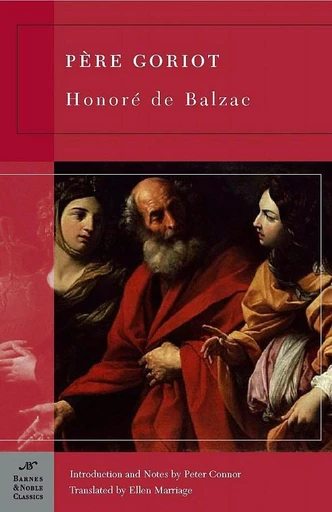
Pere Goriot (Barnes & Noble Classics Series)
Résumé
Pere Goriot, by Honore de Balzac, is part of the Barnes & Noble Classics series, which offers quality editions at affordable prices to the student and the general reader, including new scholarship, thoughtful design, and pages of carefully crafted extras. Here are some of the remarkable features of Barnes & Noble Classics:
- New introductions commissioned from todays top writers and scholars
- Biographies of the authors
- Chronologies of contemporary historical, biographical, and cultural events
- Footnotes and endnotes
- Selective discussions of imitations, parodies, poems, books, plays, paintings, operas, statuary, and films inspired by the work
- Comments by other famous authors
- Study questions to challenge the readers viewpoints and expectations
- Bibliographies for further reading
- Indices & Glossaries, when appropriate
A supreme observer and chronicler of nineteenth-century French society, Honoré de Balzac wrote a vast number of novels and short stories collectively known as The Human Comedy. These books were unsurpassed for their narrative drive and scope, their large casts of vibrant, diverse, and interesting characters, and their obsessive interest in and examination of virtually all spheres of life.
The greatest of these novels is Père Goriot, which opens in a dirty boarding-house where three of the novel’s main characters live. Goriot is a father who sacrifices his wealth and health so that his two daughters can gain access to Parisian high society. He pays off their debts, succumbs to their lavish demands, and receives nothing but scorn in return. His fellow boarder is the mysterious Vautrin, one of Balzac’s most remarkable creations. A criminal mastermind, Vautrin recognizes that the social contract is nothing but a fraud for those without money and power. Finally, there is Rastignac, who represents one of Balzac’s favorite themes—the ambitious young provincial fighting for advancement in the competitive world of Paris. With Goriot and Vautrin acting as surrogate fathers, Rastignac begins his climb up the social ladder—only to discover that there is a spiritual cost to be paid for life’s apparent prizes.
The greatest of these novels is Père Goriot, which opens in a dirty boarding-house where three of the novel’s main characters live. Goriot is a father who sacrifices his wealth and health so that his two daughters can gain access to Parisian high society. He pays off their debts, succumbs to their lavish demands, and receives nothing but scorn in return. His fellow boarder is the mysterious Vautrin, one of Balzac’s most remarkable creations. A criminal mastermind, Vautrin recognizes that the social contract is nothing but a fraud for those without money and power. Finally, there is Rastignac, who represents one of Balzac’s favorite themes—the ambitious young provincial fighting for advancement in the competitive world of Paris. With Goriot and Vautrin acting as surrogate fathers, Rastignac begins his climb up the social ladder—only to discover that there is a spiritual cost to be paid for life’s apparent prizes.
Peter Connor is Associate Professor of French and Comparative Literature at Barnard College, Columbia University. He is the author of Georges Bataille and the Mysticism of Sin (Johns Hopkins University Press, 2000). He has translated Bataille’s The Tears of Eros (City Lights Press, 1989), as well as many works in the area of contemporary French philosophy, including The Inoperative Community, by Jean-Luc Nancy (University of Minnesota Press, 1991).
Auteur
Caractéristiques
Éditeur : Barnes & Noble Classics
Publication : 1 juin 2009
Intérieur : Noir & blanc
Support(s) : Livre numérique eBook [ePub]
Contenu(s) : ePub
Protection(s) : Marquage social (ePub)
Taille(s) : 1,44 Mo (ePub)
Langue(s) : Anglais
EAN13 Livre numérique eBook [ePub] : 9781411433670
EAN13 (papier) : 9781593082857
Les promos du moment
The milky way
une romance universitaire best friends to lovers

5,99 € 1,99 €
Les oubliés de la Saint-Valentin
Des vies à l'ombre du mariage (États-Unis, XXe siècle)
16,99 € 8,49 €