


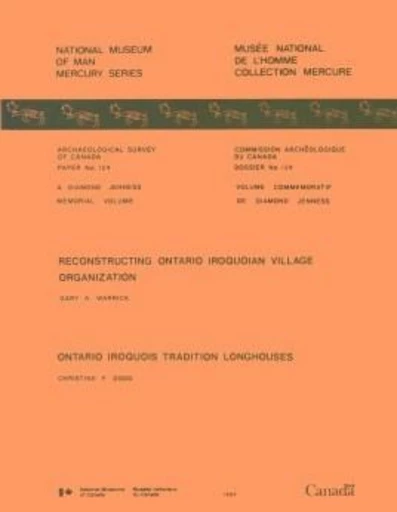
Reconstructing Ontario Iroquoian Village Organization — Ontario Iroquois Tradition Longhouses
Résumé
The first study presents a model of Ontario Iroquoian village organization, based on fourteen Late Iroquoian (ca. A.D. 1450-1650) village plans, historic documents and comparative data on contemporary communities. It is argued that socio-political factors (village demography, socio-economics and government) were the major determinants of Iroquoian village arrangement. In light of the socio-political model suggested in part one of this book, the second study interprets changes in longhouse village planning, throughout the Ontario Iroquois sequence (A.D. 700 – 1650), as responses to evolutionary trends in Iroquoian warfare patterns and political organization. Published in English.
Auteur
Caractéristiques
Publication : 1 janvier 1984
Intérieur : Noir & blanc
Support(s) : Livre numérique eBook [PDF]
Contenu(s) : PDF
Protection(s) : Aucune (PDF)
Taille(s) : 63,2 Mo (PDF)
Langue(s) : Anglais
EAN13 Livre numérique eBook [PDF] : 9781772821185