



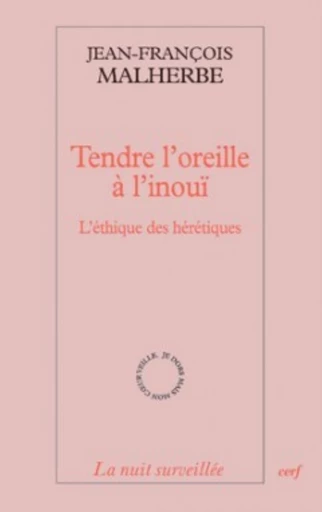
TENDRE L'OREILLE À L'INOUÏ
Résumé
--
Western philosophical tradition conceals astounding reflections on ethics. Strangely, these ideas came from thinkers who were often regarded as ‘heretics’ and who, for that reason, were deprecated, ostracized, condemned, even put to death. Heraclitus, Socrates, Epicurus, Eckhart, Spinoza, Wittgenstein and Arendt, as well as some other outcasts, expressed ideas that have never been diffused, most probably because they were ‘heretics’ - i.e. inaudible by the powers they directly or indirectly challenged. The etymology of the word ‘heresy’ is the Greek ‘hairesis’, which means ‘choice’ or ‘chosen thought’. ‘Hairetikos’ refers to a person who thinks for himself and decides autonomously. The semantic reversal is immediately apparent, from the Inquisition to our times, where it means ‘deviant’, a black sheep in a white flock, a troublemaker, a dissident, even a rebel. Yet these ‘heretics’ saw the necessity to substitute inclusion for exclusion in ethical terms. As the years and centuries went by, a strange fog of deafness has gathered around their most pertinent contributions. The author has rummaged in the archives of our culture to find some traces of an ‘inclusion ethic’. Buried in a shroud of silence, they would undoubtedly permit us, could we but hear them, to find solutions to the crises all around us today.
Auteur
Caractéristiques
Éditeur : Éditions du Cerf
Publication : 6 juin 2013
Intérieur : Noir & blanc
Support(s) : Livre numérique eBook [ePub]
Contenu(s) : ePub
Protection(s) : DRM Adobe (ePub)
Taille(s) : 338 ko (ePub)
Langue(s) : Français
Code(s) CLIL : 3126, 3081
EAN13 Livre numérique eBook [ePub] : 9782204120296
EAN13 (papier) : 9782204099646
Vous aimerez aussi

Les promos du moment

4,99 € 3,99 €


4,99 € 3,99 €



4,99 € 3,99 €