Résumé
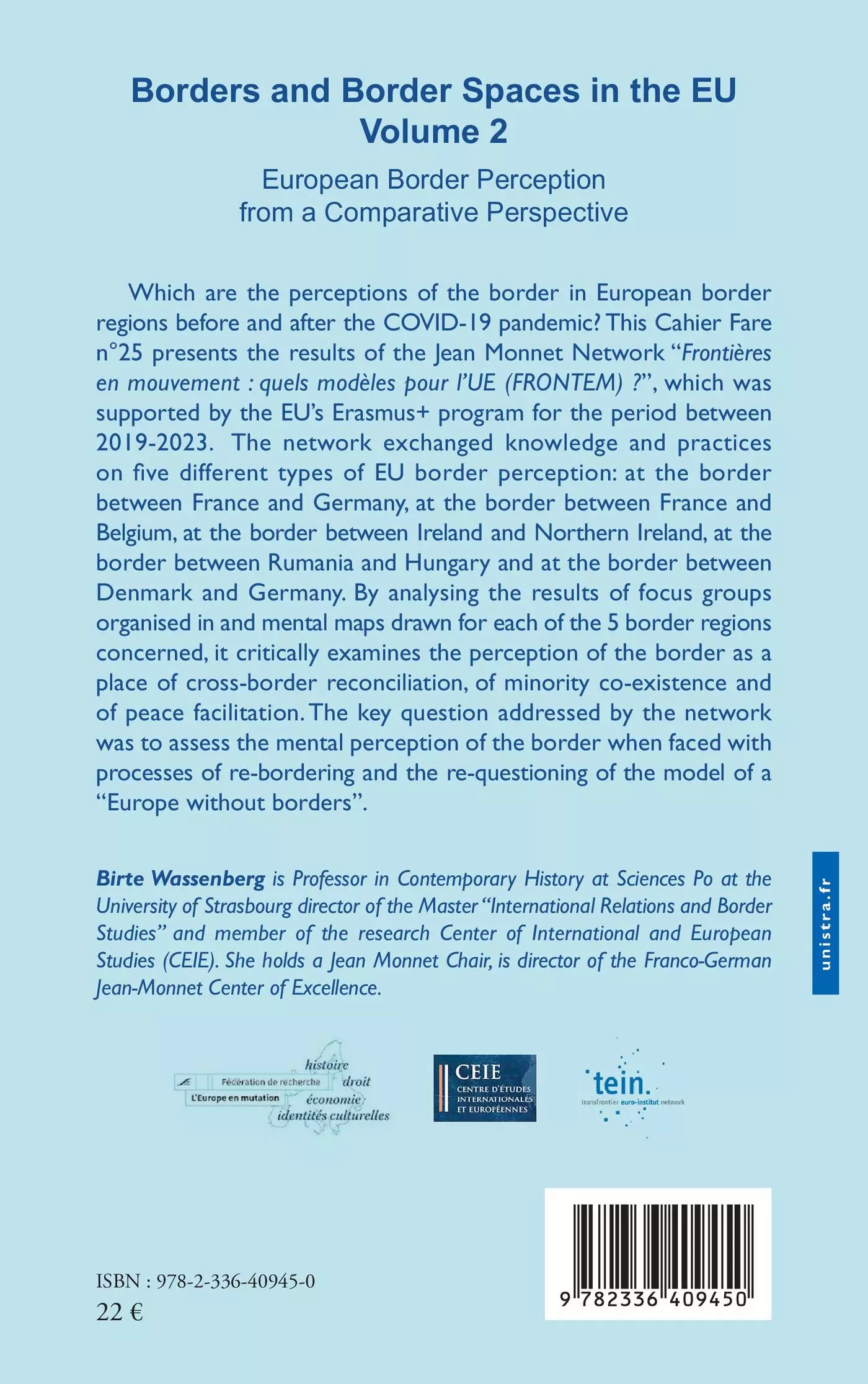
Which are the perceptions of the border in European border regions before and after the COVID-19 pandemic? This Cahier Fare n°25 presents the results of the Jean Monnet Network “Frontières en mouvement: quels modèles pour l’UE (FRONTEM)?”, which was supported by the EU’s Erasmus+ program for the period between 2019-2023. The network exchanged knowledge and practices on five different types of EU border perception: at the border between France and Germany, at the border between France and Belgium, at the border between Ireland and Northern Ireland, at the border between Rumania and Hungary and at the border between Denmark and Germany. By analysing the results of focus groups organised in and mental maps drawn for each of the 5 border regions concerned, it critically examines the perception of the border as a place of cross-border reconciliation, of minority co-existence and of peace facilitation. The key question addressed by the network was to assess the mental perception of the border when faced with processes of re-bordering and the re-questioning of the model of a “Europe without borders”.
Auteur
-
Birte Wassenberg est professeure d’histoire contemporaine à l’Institut d’études Politiques (IEP) de l’Université de Strasbourg et membre de l’UMR 7367 Dynamiques européennes. Titulaire d’une chaire Jean Monnet, elle est spécialiste de la coopération transfrontalière, de l’histoire des organisations européennes et de l’anti-européisme. Parmi ses publications récentes : La coopération territoriale en Europe. Une perspective historique, Luxembourg, Offi ce de publication de l’Union européenne, 2015 (avec Bernard Reitel).Jérôme Clerget est doctorant en Histoire contemporaine à l’Université de Strasbourg, UMR 7367 Dynamiques européennes. Il fait sa thèse avec le professeur Jean-Christophe Romer sur « L’introuvable architecture européenne de sécurité 1973-2000 ». Parmi ses publications récentes : Avec Marion Aballéa, « Introduction : Discours diplomatique et pratique des relations internationales, XIXe-XXIe siècles.», Cahiers de FARE, numéro 11, 2016, pp. 7-11.
Caractéristiques
Publication : 4 janvier 2024
Support(s) : Livre numérique eBook [PDF]
Protection(s) : Marquage social (PDF)
Taille(s) : 6,96 Mo (PDF)
EAN13 Livre numérique eBook [PDF] : 9782336409467
EAN13 (papier) : 9782336409450