



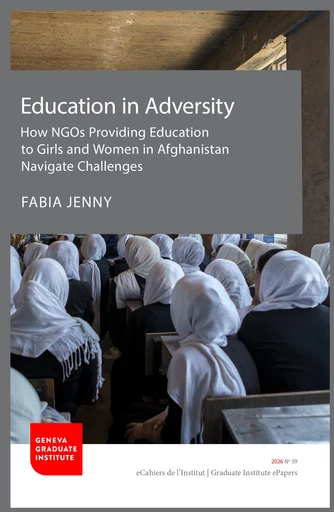
Education in Adversity
Résumé
In 2022, the Taliban prohibited girls and women in Afghanistan from attending secondary school. Still, a range of NGOs continues to provide educational opportunities. This study examines how these organisations navigate challenges and build organisational resilience in fragile and high-risk environments. Eleven interviews with NGO representatives were conducted. The findings reveal that NGOs rely on interlinked adaptive capacities, defined as resources and the ability to mobilise them, and resilience-building strategies, understood as concrete strategic actions enabled by these capacities, to respond to external challenges and build resilience. In practical terms, this study emphasises the importance of fostering intrinsic motivation and psychological well-being among volunteers and staff, promoting collaboration among organisations, and strengthening local grassroots efforts. It further highlights the role of local actors, especially women, in ensuring context-sensitive programme design and implementation. These insights contribute to a deeper understanding of how NGOs adapt to sustain education in crisis settings.
Auteur
Caractéristiques
Éditeur : Graduate Institute Publications
Publication : 22 janvier 2026
Intérieur : Noir & blanc
Support(s) : Livre numérique eBook [PDF + ePub + Mobi/Kindle + WEB]
Contenu(s) : PDF, ePub, Mobi/Kindle, WEB
Protection(s) : Marquage social (PDF), Marquage social (ePub), Marquage social (Mobi/Kindle), DRM (WEB)
Taille(s) : 876 ko (PDF), 3,95 Mo (ePub), 6,85 Mo (Mobi/Kindle), 1 octet (WEB)
Langue(s) : Anglais
Code(s) CLIL : 3290, 3081, 3000
EAN13 Livre numérique eBook [PDF + ePub + Mobi/Kindle + WEB] : 9782940600632
Vous aimerez aussi


20,99 €
37,99 €


Les promos du moment

4,99 € 3,99 €


4,99 € 3,99 €



4,99 € 3,99 €